JESSE MARTIN-DAVIS
TABULA PUBLISHERS

“My Body Is An Archive” reflects on how gender and identity are shaped, not just by individual experience, but by family, time, and place. There is no single point of origin. Instead, meaning gathers gradually through observation, memory, and repetition. Gender transition, in this context, is not a departure but a dialogue, a way of understanding the body as an archive of experiences.
I consider what it means to inhabit a body in transformation and how tenderness can exist alongside discomfort, fragmentation, and reclamation. I find myself returning to familial structures, not to find answers, but to sit with what is passed over, knowingly or unknowingly. How might these factors, of time, geography, ethnicity, and religion, quietly direct our understanding of gender?


Gender here is not fixed or declared; it drifts, it resists definition, and it carries history. I investigate how history and family can offer a path inward, as a body moving through social, hormonal, and temporal shifts. Transition and bodily change are reframed not as loss, but as a gathering of moments, sensations, and inherited histories that become resources for living.
The familial becomes both a site of origin and conflict, where ideals of femininity, masculinity, and bodily “normalcy” are reproduced. Gender here is shown not as linear or stable but as a kind of domino, shaped by past generations and continuing to shape those to come. Rather than offering a linear narrative, my artistic process becomes a space of reflection, where fragments accumulate.


Abstracted organic structures are altered, stretched, stitched, and coated to suggest skin, bone, or tissue. These are not literal representations but surfaces that feel familiar, bodies as sites of memory, pressure, and change. The materials speak of care and discomfort, of something that is still in the process of forming or that has been reshaped. As a transgender person, I engage with these inherited patterns while building a different kind of relationship with my body. My transition is not a rejection of what came before, but a continuation of these stories, reshaped through my own embodiment.
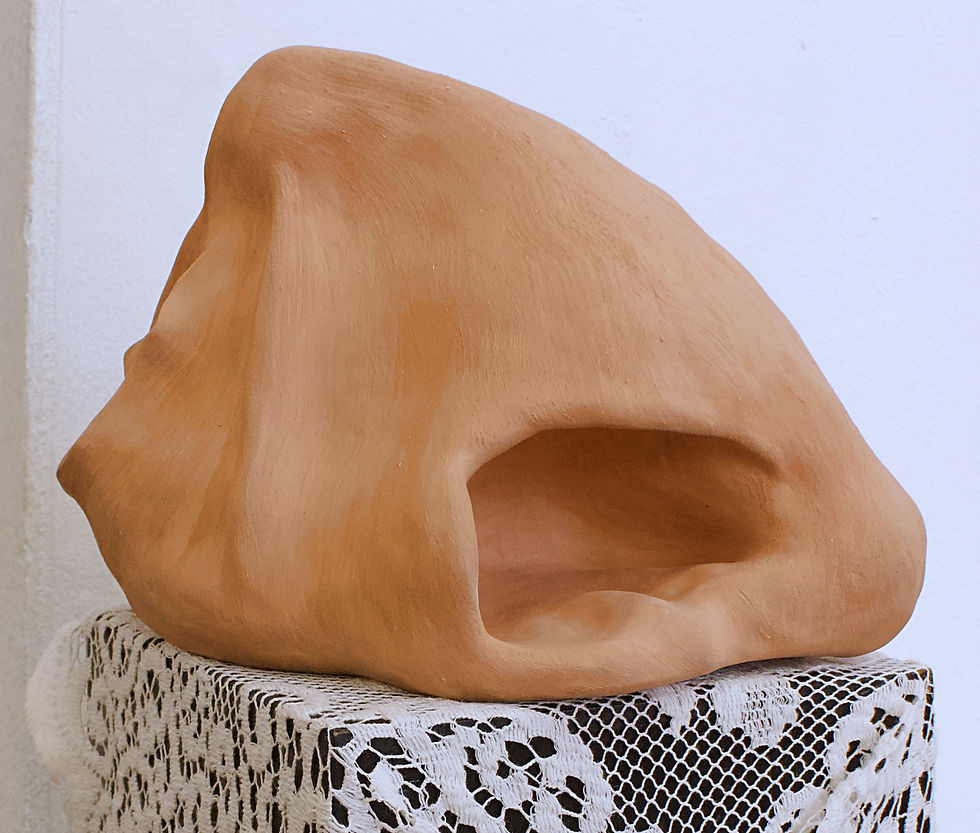

My work becomes a way of responding to the memories inscribed in flesh, to the histories that shape how we see ourselves, and to the possibility of repair within transformation. Sound and video extend this process; snippets of conversation, with parent, grandmother, and child, are collected and then distorted. These distortions become a kind of residue, fragments of memory that don’t settle cleanly.
Visual elements may stretch or collapse in response, echoing how identity feels; sometimes solid, other times porous or unstable. This is not a work of resolution but of enquiry into how gender is not only lived but inherited, imposed, and resisted. It asks how bodies carry the weight of familial memory, how transformation can become a method of both disruption and care, and how history imprints itself on flesh. In navigating these questions, the work gestures toward the possibility of agency within entanglement, not as a fixed point but as a conversation stretched across generations.